

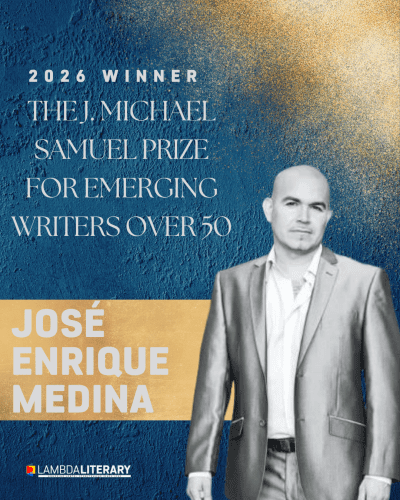
José Enrique Medina earned his BA in English from Cornell University. His poetry collection Haunt Me won the 2025 Rattle Chapbook Prize. His work has appeared in USA Today Hispanic Living Magazine, Los Angeles Review, Best Microfiction 2019, and elsewhere. He is a Voices of Our Nations Arts Foundation fellow and the founder of the Chickens & Poetry Residency for Writers. Connect with him on Instagram @MedinaWrites or at MedinaWrites.com.
Get to know José in a quick 5 Questions interview below.
Q1: What is queer resistance to you in literature?
For me, queer resistance begins with the refusal to disappear.
Queer people have been so often erased, ignored, or pushed to the margins that simply saying, “I’m here. I exist,” can be a quiet revolution. But that’s only the first step. The next step is rendering that life in three dimensions—with flaws, beauty, humor, contradiction, spirituality, desire, and risk.
We learn so early to hide ourselves. We hide out of fear of rejection, violence, abandonment, or ridicule. So telling the truth about our lives is already an act of courage. I also think queer resistance is the refusal to perform survival for a straight audience. I’m not trying to explain what it means to be gay and Mexican American. I’m trying to tell the truth as completely as I can,
knowing some readers will come with me and others won’t. That’s the risk, and also the point.
With each new book, I try to take bigger risks. In many ways, I still carry the fear I learned growing up—fear of being kicked out of the house, fear of getting beat up, fear of being seen. I don’t know if that fear ever fully disappears. But writing allows me to transform that fear into something else. Into stories that are wilder, stranger, more loving, and more honest.
Q2: How do queerness and ethnicity intersect in your writing, and what does that mean to you?
I don’t really experience my queerness and my Mexican-American identity as separate things. They’re the same river.
Growing up, though, it felt like I never fully fit into either world. When I won a scholarship to an affluent private high school, some of the white students called me things like “spic,” made fun of my accent, or treated me as an outsider because I was Mexican American. Then I’d take a two-hour bus ride home, and some of the kids in my neighborhood would tease me for being too soft, too feminine, too bookish, or not interested in sports and gangs. My mother would often find me awake long after everyone else had gone to sleep, still studying. She’d sigh and say, “You’re burning your eyelashes.”
My writing often explores what happens when love, faith, family, and identity don’t fit neatly into the stories we’re given. When I write now, I intentionally make my characters unapologetically queer and unapologetically Latino. Public life didn’t always allow me to see those identities existing openly together. Internally, they’ve always belonged together. Writing gives me a chance to say: if the world were less fearful and less restrictive, this is what I would look like. This is how I would move through the world.
Q3: What do you hope queer readers take from your writing?
Permission.
That’s the word that keeps coming to me.
Different readers will take different things from my work. Some may love it. Some may not connect with it at all. But I hope they see someone taking a risk on the page and think, “Maybe I can take a risk, too.”
I hope queer readers feel permission to be multiple things at once. To be funny and devastated. Spiritual and skeptical. Strong and vulnerable. I hope they feel permission to be unresolved. I also hope the work offers companionship. Many of my poems deal with loneliness, grief,
longing, family, and the desire to belong. If someone feels a little less alone after reading them, that’s meaningful to me.
After reading my first chapbook, a Latinx professor told me the book “rearranged her DNA.” I don’t know if I’ll ever hear anything better than that. What moved me wasn’t the praise; it was seeing what happened afterward. Her poems stopped asking permission. The chola came out. I remember reading the new poems and thinking, Wow, this woman is fiercer than I am now. What surprised me was that it didn’t stop there. Her transformation freed me up, too. It made me want to take my own work up a notch. To push further.
Q4: How have your lived experiences impacted the stories you tell?
Almost everything I write grows out of lived experience, even when the work becomes surreal, speculative, or imaginative.
Growing up in East Los Angeles, losing my mother, navigating life as a gay Mexican-American man, working-class life, faith, family—all of those experiences shape the subjects I return to. The dead in my poems aren’t abstract concepts. They’re people I actually loved and lost.
I think most writers use lived experience as raw material. The difference is how much of yourself you’re willing to risk revealing. As I’ve gotten older, I’ve become more interested in exposing parts of myself that I once thought
I would never share. Sometimes I think of the closet as a physical thing. It’s as if my body spent years curled inward, cramped and compressed. Writing allows me to uncurl a little. To stretch. To stand taller—not in a proud or superior way, but in an “oh, let me breathe this air” kind of
way.
What’s interesting is that the more truthfully I write about myself, the freer my imagination becomes. The more honest I am, the stranger and more inventive the work can get. It’s almost an inverse law. The more truth you’re willing to tell, the stronger the foundation becomes. Once the reader trusts that foundation, you can wander much farther from reality. You can become surreal, speculative, even impossible, and the emotional truth still holds. I’m not interested in simply recording experience; I’m interested in discovering what experience means.
Q5: What do you hope that the future of queer literature looks like?
What do I hope the future of queer literature looks like?
I hope it’s a weird-ass monster.
I hope it’s Frankenstein—cut into pieces, retrofitted, stitched back together in our image, our vision, remade to fit our needs and desires. I hope it causes fear in the hearts of our enemies—not the fear of physical harm, but the fear of a tradition turned upside down, of a canon cracked open, of everything they thought was theirs now unrecognizable.
Because here’s the catch: we’re writing with the enemy’s words. Adrienne Rich knew this. She wrote, “I cannot touch you and this is the oppressor’s language.” One line holds the whole problem—political and intimate at once. The language doesn’t just oppress us in the street or in the law. It stands between our bodies. It makes tenderness harder. It makes us reach through bars just to find each other.
So the revolution has to be made from inside the cell. From the parts and pieces we find lying around. The curtains torn from the walls. The chairs broken into weapons, refashioned into something new.
That’s what the queer writers who came before us did. They stretched the boundaries of what could be said, who could say it, and how it could be said. They made my work possible.
I hope the next generation does the same. I hope I read a book and think, I can’t believe this writer took that risk. I didn’t even know that was possible. Some of my favorite books have given me that feeling. They didn’t just tell a new story; they expanded my sense of what literature itself
could do.
I hope the future of queer literature makes me furious and jealous and grateful all at once. I hope it’s wilder than anything I can imagine. I hope it makes more room.
Most of all, I hope it’s a monster.
And I hope it’s beautiful.
