

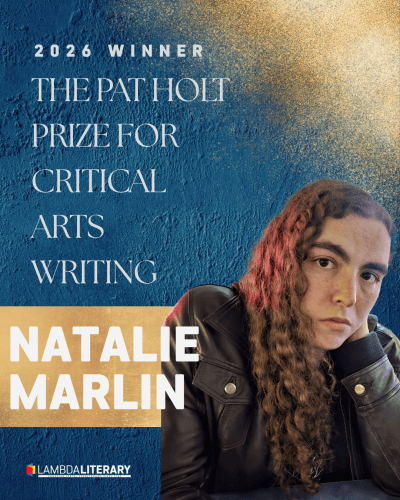
The Pat Holt Prize for Critical Arts Writing is presented in memory of the celebrated author and long-time SF Chronicle book review editor Patricia Holt and honors LGBTQ Critical Writing on Arts & Literature. The award will go an LGBTQ arts critic or literary reviewer committed to examining queer works of art and culture, as Holt ground-breakingly did for 16 years. This award is made possible by Lesbians for Good, a fund of the Horizons Foundation, and includes a cash prize of $4,000.
Natalie Marlin is a writer and critic based near Minneapolis, MN. Her writing on music, film, and arts has since been featured in publications such as The Quietus, Bright Wall/Dark Room, Stereogum, Racket, Reverse Shot, Little White Lies, Pitchfork, and more. Her work spans critical reviews, profiles and interviews, essays, and scene reports, with a focus on queer and trans artists, experimental art as a queering of form, and the intersection of DIY arts scenes and activist organizing. Her first book, Noise Music, is forthcoming with Bloomsbury Publishing.
We get to know Natalie in a quick 5 Questions interview below.
Q1: What is queer resistance to you in literature and art?
Being queer is, by nature, an assertion of resistance against the cisheteronormativity that would sooner see us assimilated or erased out of existence. I find that the literature and art that best embodies this resistance is the kind where we make no apologies and refuse to sand ourselves down, the kind that invokes the same disruption we carry in our very beings. If the personal is inherently political, to be an artist of queer resistance is to understand how our bodies, our sexualities, and our personhood are politicized by virtue of the threat they pose to the hegemony, and to then redirect that into unflinchingly outspoken and serrated art. The only way resistance is understood as proper resistance is as a loud, uncompromising, and impassioned force of reckoning—anything less is an acquiescence to the very forces we must resist to achieve liberation.
Q2: What is the most meaningful project or piece of work that you have worked on that has intertwined itself with your identity or queerness?
I love crafting essays at the intersection of criticism and personal reflection, because these projects let me interrogate the art I love and probe how it has shaped me. The first of these I pursued professionally—an essay titled “Starting to Feel Small Again,” about vocal synth technology and how I filtered trans voice dysphoria through it, via the work of the musician Twinkle Park—was vital in helping me vocalize how my artistic fixations can become vessels to parse how I understand my embodied queer/trans life.
But the most meaningful of these essays has been “Laughing With the Pain,” where I dissected only finding poignance in the Jackass films after transitioning, and tumbled into a deeper examination of the transmutation of trans pain—in physical, social, and otherwise abstract senses. In considering why so many trans people in my life shared this affinity for the series, I began to make sense of the catharsis that comes with confiding in and joking about shared pain with trusted parties, and why we may cope with the unwanted hurt forced upon us by subjecting ourselves to a more palatable pain on our own terms. I think this essay is emblematic of the kind of work that is most powerful for me, as a writer and a reader—work that understands that we are intrinsically shaped by the art we take in, and that our personhood, in turn, shapes our responses to art, regardless of whether people like us were ever an intended audience for it.
Q3: Which queer authors or artists have inspired you in your own career?
It feels near-impossible to narrow down my inspirations in queer art to a handful of names, but my interest in queer writing began—like many queer women before me—with finding Virginia Woolf and Emily Dickinson from a young age. I likely would not have admitted my own queerness to myself in early adulthood if I had not been shown Tony Kushner’s Angels in America, a play I still consider the great American literary work of queerness in all its scope. It’s a fortunate problem to have too many remarkable contemporary queer writers to name in the space of one answer, but some of the most impactful for me have been Imogen Binnie, Anna Moschovakis, Lauren Cook, Amy Berkowitz, K-Ming Chang, Soula Emmanuel, T Fleischmann, imogen smith, and Carmen Maria Machado. In the realm of criticism, I would not have been able to envision myself in this field at all if not for seeing trans writers like jj skolnik, Niko Stratis, and Sasha Geffen publishing work in spaces I dreamed to occupy. Because I am such a multidisciplinary writer, I feel just as indebted to renegade works of queer film and music—to Derek Jarman, the Wachowski sisters, Gregg Araki, Jane Schoenbrun, Sally Potter, and Yann Gonzalez in the former medium; and to SOPHIE, Owen Pallett, Jordaan Mason, G.L.O.S.S., Ada Rook, and Hazel M. in the latter. And then there are the writers I feel such a deep personal kinship with, where it is not just their work that bolsters and invigorates me, but their tremendous generosity as peers beyond the page: it is difficult to fathom a sense of queer/trans community that does not involve my friendships with torrin a. greathouse, Katherine Packert Burke, Alice Stoehr, and Casey Plett.
Q4: What kind of stories do you find to be underrepresented, and that you’d like to see more of in LGBTQ+ literature?
I hope to see more stories of queer mundanity, about queer and trans people simply living, in the same ordinary circumstances so many of us do. And by that same token, I want to see just as many stories about queer transgression, and for these stories to be given the grace allowed straight and cis narratives along the same tack. I want to read more stories about the messy queers, the ones who give in to the same maladaptive tendencies and bad decisions so many of us do. I think the most human writing of queerness and transness is writing that does not shy away from this, that exposes all the warts of queer and trans life as any other life may hold. We are all as capable of deep flaws and misplaced judgment as anyone else may be, and we still have so much ahead of us when it comes to exploring why we might end up in these scenarios—how our systemic inequalities affect how we experience financial, romantic, domestic, bureaucratic, professional, and interpersonal difficulties.
I’m also hopeful that queer and trans art can get even weirder and more experimental from here. Form and narrative structure are just normative apparatuses for us to break the boundaries of, to queer as we would any other facet of our expression. I have a tremendous place in my heart for exceptional queer and trans art in specific literary traditions, but I get thrilled anytime I read a work from a queer or trans author that feels like nothing I’ve ever read before, because it feels as if I’m witnessing us charting a path of articulation that is wholly our own. I get so enthusiastic for the future of queer art because it feels like we still have so much runway in front of us. Now that the ground has been primed, I’m eager for us to pave more expansive queer futures ahead.
Q5: What advice would you give to aspiring queer writers?
Be stubborn about taking up space. The truth behind my writing is that I’ve never had a piece of work emerge without first asserting myself in a space that does not intentionally seek to accommodate me. This still happens to this day, and I keep asserting myself because it is the only way I have consistently made a profession of this work. It is my belief that—because we have so few large-scale institutional accommodations for explicitly queer and trans art, and we may very well never see that change in our lifetimes—it is up to us to wrest the attention and opportunities we deserve, to make our voices heard at such a volume that they cannot be ignored. Few will ever be quicker to grant us the grace to write than other queer and trans people; by this metric, each of us should be our own first advocate for the space we deserve. Do not give up, even in the face of silence or apathy at your work. If you believe you have something to say, say it until someone listens. I assure you: someone will want to listen. All you must do is keep saying it, even if you must talk yourself hoarse. If persistent and assured, a sharp, unyielding voice will carve out its rightful place.
