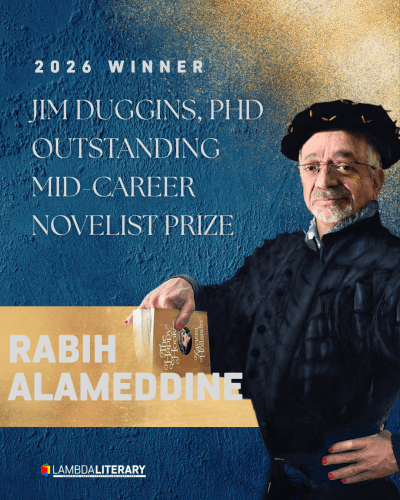
The Jim Duggins Outstanding Mid-Career Novelist Prize honors LGBTQ-identified authors who have published multiple novels, built a strong reputation and following, and show promise to continue publishing high quality work for years to come. This award is made possible by the Horizons Foundation, and includes a cash prize of $5,000.
One of two winners of this year’s prize, RABIH ALAMEDDINE is the author of the novels The Wrong End of the Telescope; The Angel of History; An Unnecessary Woman; The Hakawati; I, the Divine; and Koolaids, as well as the story collection The Perv. His books have been translated into more than 20 languages.
His most recent awards include the 2019 Dos Passos Prize, the 2021 Lannan Prize for Fiction, the 2022 Pen/Faulkner award and the Bill Whitehead Lifetime Achievement Award in March 2025. He recently co-edited The Penguin Book of the International Short Story, and his new novel, The True True Story of Raja the Gullible (and His Mother) won the National Book Award for Fiction. He divides his time between his bedroom and his living room. We get to know Rabih in a quick 5 Questions interview below.
Q1: What is queer resistance to you?
Sometimes I think the most important resistance is existence. Or to use meme speak: existence is resistance. The fact that we are still here after all that has been done to us. Killings, torture, persecution, rejection and silencing. We’re still here. I once wrote: Queers are life butterflies–if you see us flitting about, it means the environment is healthy. I’m still flitting about.
Q2: What is the most impactful piece of queer literature that has resonated with you, and
why?
That’s a difficult question to answer because different works are impactful at different ages. When I was a teenager, what I needed was to see queers represented in literature. When I found out that many of Shakespeare’s sonnets were written for a boy, I was exhilarated. I read Holleran’s Dancer from the Dance and was comforted by reading about other queers. But it probably was André Gide’s Corydon that was the most influential. It meant the world to me when I was growing up. It consists of Socratic arguments about homosexuality, originally published in 1911 with only a dozen copies. I believe Gide was the first openly gay man to win the Nobel in 1947.
Q3: How do queerness, race, and politics intersect in your writing, and what does that
mean to you?
I’m not exactly sure how they intersect, but they most certainly do. It is difficult to quantify. I can say that queerness, race, and politics intersect in me and everything that’s me informs my work. I’m a terribly political person, which influences how I see the world. When I’m writing, I rarely think about political, racial, or queer issues, but they seep into my work because they are a major concern in my life.
Q4: What advice would you give queer writers who want to tell stories similar to yours?
Go for it. Do it. It has been my experience that most writers, queer or not, rarely finish what they start for some reason or other. In my mind, writing needs talent, skill, luck, and persistence. The last is what a writer has most control of, so keep at it.
Q5: Which queer authors or artists have inspired you in your own writing and art?
Ah, so many, so many. Let me start with the great French writer, Marguerite Yourcenar. She was a lesbian, partnered with Grace Flick, yet she had a habit of falling in love with gay men. All her novels (that I know of) have a gay man as the main protagonist. Her most famous novel, Memoirs of Hadrian, is arguably the greatest queer novel of all time. Might be my favorite novel ever, queer or not. The love affair between Hadrian and Antinous is both wonderful and disturbing. The book is pitch perfect, not for a moment does one think it is not written by Hadrian himself. I reread it during the AIDS years and soaked the book with my tears. Hadrian’s grief for his dead lover was everyone’s. I’m not sure I would have been able to write my first novel if not for Hadrian.
Allow me to list a few names just for the hell of it: Patrick White, Edmund White, Sarah Schulman, Manuel Puig, Pedro Lemebel, Justin Chin, Peter Nádas, Michael Cunningham, Jerome Caja, Justin Chin, James Merill, Audre Lorde, Frank O’Hara, John Ashbery, Cy Twombley, and so many more.