


The Denneny Award for Editorial Excellence is named in honor of Michael Denneny, who founded the first ever LGBTQ+ imprint at a major publishing house, was essential in the publishing of literature dealing with the HIV/AIDS epidemic, and so generously shared his talents with writers right up until the end of his life. The award will go to an editor whose commitment to the publication of LGBTQ+ writers and literature contributes significantly to the advancement of the LGBTQ+ community. The Denneny Award is the only editorial award that not only recognizes the support provided by editors to the literary community, but also the importance of editors in the advancement of a social movement. The winner will receive a cash prize of $2,500.
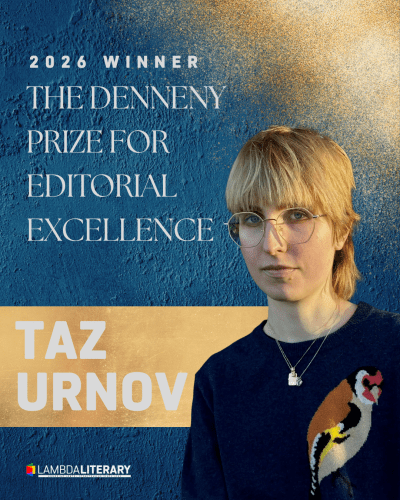
Taz Urnov is an editor at New York City–based independent publisher Soho Press, curating crime and horror fiction for the imprints Soho Crime and Hell’s Hundred. They joined Soho in 2021 following work in translation, linguistics, and education. Taz’s acquisitions for Soho have been reviewed in the New York Times, Wall Street Journal, Los Angeles Times, and Washington Post and won notable literary awards including the CWA Dagger, Anthony Award, Shamus Award, and ALA Reading List Award.
Raised in the San Francisco Bay Area and DFW metroplex on a steady diet of books and the Beatles, she is fluent in Russian and French and plays the bass in two bands. We get to know Taz in a quick 5 Questions interview below.
Q1: Has your position as an editor ever made you learn more about yourself through the literature you read, and how has that impacted your work?
Like a sponge, I soak in quite a lot from the things that surround me. I’ve edited big-hearted books that have filled me with hope that humanity can grow in the direction of goodness; I’ve edited quirky books that have treated failure with compassion and made me feel less alone in fumbling through mistakes to better outcomes; and I’ve edited dark books that have shown me that even when I feel at my worst, I really don’t have it that bad after all. In historical fiction, I’ve been surprised to see so many of the issues or themes that affect the LGBTQ+ community today on full display decades (or even hundreds) of years ago. In international fiction, I’ve learned so much about the similarities and differences between queer lives across the globe. When I was growing up, reading made me feel less alone; now, as an editor, I have the privilege of helping convey all kinds of stories to the world at large, in the hopes of sharing a little corner of community.
Q2: What is the most impactful piece of queer literature that has resonated with you, and why?
Rebecca Dinerstein Knight’s Hex is a book I’ll go to my grave loving. When I first read it, I was at a time in my life when all I wanted was love and guidance, and joining Nell along her journey, I felt more reflected on the pages of a book than I ever had before; it was like the pages were mirrored. The messiness and earnestness and well-intentionedness of the book’s central characters in their disastrous queer love hexagon—how they can hurt but forgive one another—how love, ultimately, is possible (and maybe the only true thing in this world), though certainly not in the ways we expect or even understand—I’ll never forget the lessons this book taught me about desire and attention and self-esteem, and I still quote it all the time, because the narrative voice is just delectable. “We’re starting into our new days now” indeed.
Other formative favorites: Madeline Miller’s The Song of Achilles—at the time, it was so radical and yet so simple to fill in the missing piece of the previously unsatisfactory reason for Achilles’ rage: that these two men were in love. Everything else which had been similarly confusing or unspoken made so much more sense after that. Much of the Beatnik canon, which was appealingly transgressive yet joyous. The work of Donna Tartt, which features soul-to-soul connections undefinable by any traditional model of attraction or label (though I have my theories). Finally, an honorable and loving mention to the millions of words of fanfiction I ingested religiously from my tween years onward.
Q3: What do you hope the future of queer literature looks like?
I hope we can tell real, honest stories. I’ve read a handful of such books already that felt almost too risky to put out into the world, due to the way they show authentic, unvarnished queer existence—good, bad, weird, lovely, ugly, and true—and I want more! I hope to read stories that really cut to the quick of human behavior. I’m less interested in buzzwords, trends, and tropes than I am in the underlying mechanisms of why we do the things we do and what makes us who we really are, so I hope queer literature—without censorship or restriction—continues pushing boundaries and daring to ask (and, importantly, attempt to answer) big questions, even if getting there can sometimes be uncomfortable.
Q4: What advice would you give to queer writers trying to emerge into the literature and editing industry?
Write what’s in your heart—never for an imagined audience—and your real audience will be waiting for you.
Q5: What kind of stories do you find to be underrepresented, and that you’d like to see more of in LGBTQ+ literature?
For years, I’ve been passionate about the culture and causes of the Deaf community; it would be marvelous to see that group represented more frequently in literature at large, but I’d especially love to read more LGBTQ+ novels by and/or from a Deaf perspective. I’m also very interested in non-Western ideas of gender. It’s a rare thing to read a book about, but the few I’ve read I’ve loved.
