

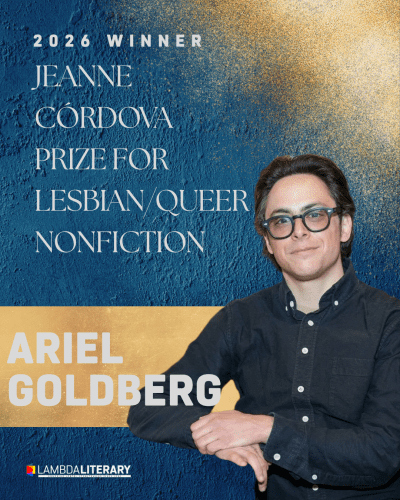
Lambda Literary’s Jeanne Córdova Prize for Lesbian/Queer Nonfiction, in memory of the beloved activist and author, honors lesbian/queer-identified women and trans/gender non-conforming nonfiction authors. The award will go to a writer committed to nonfiction work that captures the depth and complexity of lesbian/queer life, culture, and/or history. The winner of the prize will have published at least one book and show promise in continuing to produce groundbreaking and challenging work. The award was introduced in 2018 and includes a cash prize of $2,500.
Ariel Goldberg is a writer, curator, educator, and conflict mediator. Their books include The Estrangement Principle (Nightboat Books, 2016) and The Photographer (Roof Books, 2015). Images on which to build, 1970s-1990s, which tells the story of six political education projects, is forthcoming from Inventory Press + Leslie-Lohman Museum of Art in 2027. A forthcoming companion book on trans and queer photographic histories, Seeking Captions, received a 2026 New York State Council of the Arts grant, 2024 Diamonstein-Spielvogel Fellowship at New York Public Library; and a 2020 Andy Warhol Foundation’s Arts Writers Award.
Goldberg has curated public programs and exhibitions at venues including Magnum Foundation, The Poetry Project, Leslie-Lohman Museum of Art, and Center for LGBTQ Studies at the City University of New York (CLAGS). Goldberg teaches photography, writing, and contemporary art practices independently and at The New School. They are a proud member of Academics Come Together—United Auto Workers (ACT-UAW) Local 7902 and Jewish Voice for Peace (JVP). Goldberg works as a conflict and divorce mediator as part of the Queer Mediation Cooperative. We get to know Ariel in a quick 5 Questions interview below.
Q1: What is queer resistance to you in literature?
Paying attention, being honest, reading widely, and bringing people together.
Q2: What is the most meaningful project or piece of work that you have worked on that intertwines with your identity or queerness?
I’m adapting an exhibition to a book, Images on which to build, 1970s-1990s, and its subject are six multimedia political education projects. This basically hits on all parts of my life, photography, organizing, education, art.
Q3: Is there a specific photograph portraying queerness in any sense that has resonated with you, or inspired you in your career?
There are so many! To name a few, Berenice Abbott and Elizabeth McCausland, who were a photographer and art critic/historian couple from the 1930s-1960s. I am particularly drawn to image and text combinations of photographers taking pictures, and any clues to the process.
Q4: What are your hopes for the future of queer literature and art?
Here in the U.S. more militancy and more solidarity with the Palestinian Academic and Cultural Boycott of Israel (PACBI).
Q5: Which queer authors or artists have inspired you in your own career?
I am inspired by Jeanne Córdova! Writers who are uncompromising in how they bear witness and provoke readers to act. Lately, I keep returning to Linda Villarosa’s speech, “We have to fight for our political lives” from 1995 in OutWrite: The Speeches That Shaped LGBTQ Literary Culture (2022 Edited by Julie R. Enszer and Elena Gross).
