

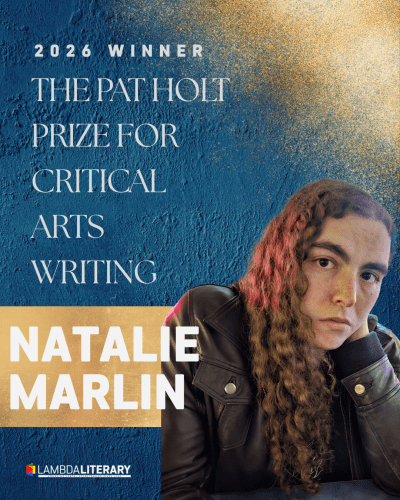
Lambda Literary is pleased to announce Natalie Marlin as the winner of the Pat Holt Prize for Critical Arts Writing!
The prize is presented in memory of the celebrated author and long-time SF Chronicle book review editor Patricia Holt and honors LGBTQ Critical Writing on Arts & Literature. The award will go an LGBTQ arts critic or literary reviewer committed to examining queer works of art and culture, as Holt ground-breakingly did for 16 years. This award is made possible by Lesbians for Good, a fund of the Horizons Foundation, and includes a cash prize of $4,000.
Natalie Marlin
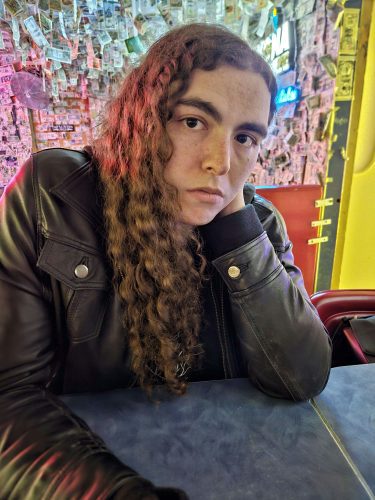
Natalie Marlin is a writer and critic based near Minneapolis, MN. Her writing on music, film, and arts has since been featured in publications such as The Quietus, Bright Wall/Dark Room, Stereogum, Racket, Reverse Shot, Little White Lies, Pitchfork, and more. Her work spans critical reviews, profiles and interviews, essays, and scene reports, with a focus on queer and trans artists, experimental art as a queering of form, and the intersection of DIY arts scenes and activist organizing. Her first book, Noise Music, is forthcoming with Bloomsbury Publishing.
Natalie Marlin's engaging writing on music and popular culture and the significance of these fields for queer and trans communities makes Marlin an outstanding voice in arts writing and one to watch closely. Marlin's criticism, profiles, and interviews demonstrate a great sensitivity to both subject and audience, moving fluidly between close observation, introspection, and political urgency. Whether profiling up-and-coming queer musicians, reporting on local music scenes, or eloquently braiding personal experience with reflections on Jackass, Marlin consistently draws in the reader from the first sentence, sustaining their interest throughout her pieces. As readers of the work, we were impressed by the author's embeddedness and consideration of community, and we hope that this prize will help Marlin to sustain a critical writing practice.
2026 Holt Prize Judges
A Word from Natalie Marlin
A decade ago, I never could have fathomed a trans writer winning a prize like this. I was coming into my gender when it felt like trans voices were just beginning to proliferate. It’s a strange feeling, being on the precipice—an artistic world filled with people who resembled me felt possible, and yet still so intangible, so abstract.
I’m astounded at the rigor of thought and scope in trans arts and criticism now. I’m tremendously lucky to live through an abundance of complex trans work, on joy, love, pain, community, memory, time, disability, grief, and place, and how each intersects with our genders and sexualities, how our transness informs the ways we experience our lives, the world.
But as our art becomes more intricate, I see a pressing need: to cultivate a multitude of trans voices in criticism. Criticism is in a tenuous state, with institutions shuttering, stakeholders deeming criticism expendable. The few salaried footholds for trans critics get slimmer and slimmer. At the outset of my career, I could count on one hand the number of trans peers employed full-time as critics; now, that number is even lower. I see this as a failure to fully mine trans art for all its worth, a diminishing of how lived experience impacts critical perspective, akin to chasing a shadow and presuming you can recreate its three-dimensional body.
There is a material danger to this refutation, too. Trans art is more visible than ever, yet more threatened in that visibility. Our life-saving care, our trans youth, our basic human rights are threatened daily, not least by publications fearmongering about our presence. It is impossible to uncritically celebrate this moment when, in the span of writing this, Juniper Blessing and Eryka
Caldwell were hatefully murdered. Narratives that stoke violence against us boil because we are given so few opportunities to speak in our best interest. No one can speak to our lives like us, and no one knows how to best build our resilient futures like us.
In Minneapolis, our queer arts scene reaches toward that future. Our arts spaces spearhead supply drives, rent fundraisers, and support for unhoused neighbors. Under ICE’s occupation, artists, musicians, writers, and critics were among the hundreds of thousands fighting against
the terror waged on immigrants and citizens of color. Our struggles are entwined in our neighbors’—the struggles against fascism, government-sanctioned violence, infringements on our bodily autonomy and homes. Here, our artistic communities are the very same that hold us
in crisis. My hope is for criticism, too, to bolster all us marginalized. I thank Lambda Literary for this prestigious honor, and emboldening what queer futures we can make. And I thank every queer artist I have encountered, for teaching me the breadth of what queer art can be. There is no earnest criticism of queer art without a deep care in one another, a devotion toward seeing us thrive—free, unapologetic—in spite of those who wish us ill. The criticism I believe in echoes that community of care.
