

Lambda Literary is pleased to announce Tausif Noor as the winner of the Pat Holt Prize for Critical Arts Writing!
The prize is presented in memory of the celebrated author and long-time SF Chronicle book review editor Patricia Holt and honors LGBTQ Critical Writing on Arts & Literature. The award will go an LGBTQ arts critic or literary reviewer committed to examining queer works of art and culture, as Holt ground-breakingly did for 16 years. This award is made possible by Lesbians for Good, a fund of the Horizons Foundation, and includes a cash prize of $4,000.
Tausif Noor
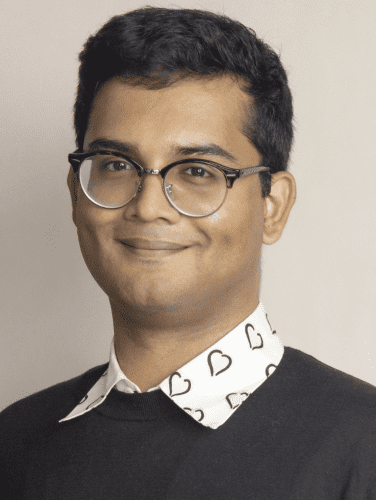
Tausif Noor is a critic and curator whose writing has appeared in publications such as the New York Times, the New Yorker, the New York Review of Books, Aperture, frieze, and The Poetry Project Newsletter, as well as various artist catalogues and edited volumes. He is the recipient of a 2022 Andy Warhol Foundation Arts Writers Grant for Short Form Writing and the 2023 Grace Dudley Prize for Arts Writing from the Robert B. Silvers Foundation. Based in Oakland, California, he is a PhD candidate in the history of art at the University of California, Berkeley and Curatorial Associate at the Berkeley Art Museum and Pacific Film Archive.
Tausif Noor's writing is engaging, understandable, and clear, without flattening the complexity of the artists' work. In each of his, samples we saw the purpose of his works in a well organized manner. Tausif thoughtful criticism reminds readers of the stunning complexity of queer life and contributes a crucial transnational perspective to our understanding of contemporary art. He encouraged a space for other to feel comfortable expressing themselves. This collection of reviews and interviews offers insight not only into queer art, but into queer companionship, migration, and collectivity.
2025 Holt Prize Judges
A Word from Tausif Noor
A few years ago, I was living in Philadelphia—the city of brotherly love—and heard about an installation and performance project that was taking place at a project space called Icebox. Artists across the city had been preparing for it throughout the fall, and it was opening in October, which was appropriate because the installation was a haunted house. Not just any haunted house, though—a queer feminist haunted house called Killjoy’s Kastle, organized by the artists Allyson Mitchell and Deidre Logue, who had previously staged versions of the Kastle in Toronto and Los Angeles. Mitchell and Logue were responding to the history of “hell houses,” installations made by evangelical Christians to scare kids off from the supposed “evils” of homosexuality, abortion, drug use, and all manners of sin. Their spin on it was to raise some hell of their own, putting a radically queer, lesbian, and feminist spin on things, bridging together lessons on the history of queer activism and resistance delivered by tour guides with gaudy, campy installations, like Mitchell’s large lesbian Sasquatch monsters.
Thus intrigued, and on assignment for an art magazine, I went to visit Icebox, where I was treated to a tour of the show by a guide dressed up as a “demented women’s studies professor.” Together, our group navigated the low-fi, high-energy installation, organized around the idea of the “feminist killjoy”—a term coined by the scholar Sarah Ahmed in 2010 to describe the mischaracterization of queer feminists as cheerless downers who refuse to play the games of patriarchy. The installation, like those before it, was tailored to the queer history of Philadelphia, a product of collaboration and research from organizations like the William Way LGBTQ archives and individuals like Welsey Flash. We learned about the history of queer spaces, advocacy groups, and parties in Philadelphia past and present, and it’s likely that many of these spaces and events have too, become a product of the past.
At the end of the exhibition were a series of white posterboards listing all the performers, collaborators, community consultants, and donors for the show in simple, handwritten letters in black marker. I wasn’t expecting then, to start tearing up; the posters reminded me of the images I’d seen of activists and protesters who marched in the streets to fight for LGBTQ rights, who still march in the streets today protesting for those same rights, to fight for an end to genocide, an end to war, an end to oppression.
Now, as then, we fight for a better, freer world. Our liberation in the future is one contingent on the past and present. The work I do as a writer is inextricably linked to what has come before me, and my own goal is to make that feel possible for those that come after me. My own writing on visual art, literature, film, and poetry draws from the wealth of contributions made by queer artists, curators, scholars, and activists in a global sense, across time, space, and borders. In my writing, I do my best to pay attention to the conditions under which work is made, conditions that were and continue, in many places, to be marked by oppression and restriction. I have always understood the social and political context of an artwork to shape its production and reception, and these contexts guide how I research, write about, and understand works of art.
I am grateful to Lambda Literary for recognizing my writing with the Pat Holt Prize for Critical Writing. Thank you to the judges for their thoughtful review and the generous prize, and to the staff and interns at Lambda Literary, especially LeKesha Lewis and London Evans, for their coordination and administrative support. And, as always, I am thankful to the many artists who have made all my work possible. There’s no perfect time to take the leaps and risks required to produce art. I am inspired by the people, living and dead, who have so poignantly understood this demand. As the queer feminist haunted house teaches us, those who are gone from this mortal realm are never really gone: their work, and the lessons we can learn from it, lives on.
