

Lambda Literary has played a pivotal role in nurturing the development of exceptional new LGBTQ writers through the Writers Retreat for Emerging LGBTQ Voices, internships, and writing and performance opportunities. Supporting emerging LGBTQ writers is central to our mission: they are the future of LGBTQ literature. The Judith A. Markowitz Award for Exceptional New LGBTQ Writers recognizes LGBTQ-identified writers whose work demonstrates their strong potential for promising careers. The award includes a cash prize of $1,500. Two prizes are awarded annually.
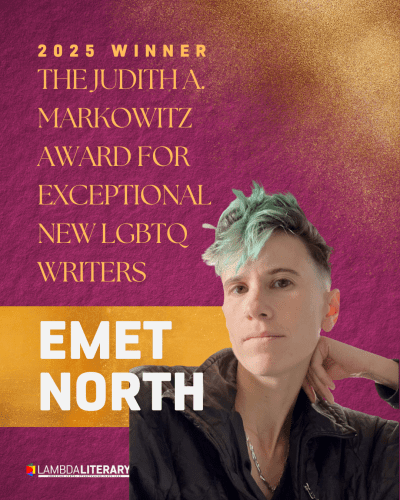
Emet North is a winner of the 2025 prize and has lived in a dozen states over the past decade and has no fixed residence, though they feel most at home in the mountains. In previous lives, they worked in an observational cosmology lab on a grant from NASA, taught snowboarding in Montana, researched Lie algebras, trained horses, and wrote a thesis on the many-worlds interpretation of quantum mechanics. Their debut novel, In Universes, was the winner of the 2024 Otherwise Award and was named one of the New York Times’ 10 Best Science Fiction and Fantasy Novels of 2024. They translate from Spanish to English with a particular focus on queer and trans voices and are always looking for new projects.
We get to know Emet in a 5 Questions interview below.
Q1: How does your queer identity inform your work in the literary world?
When I first began writing fiction, I didn’t think of myself as queer. But something strange kept happening—I would try to write a story and it would flatly refuse to work until I made the protagonist queer. Then, like magic, the pieces would come together. In order to be able to write, I had to understand who I was as a person. In other words: my queer identity is a prerequisite for my literary work.
Q2: Are there any queer figures that inspire you/your work in this field?
There are so many queer authors who have inspired me, taught me, and expanded my notion of what a story or a life could be. Among them: Akwaeke Emezi, Rivers Solomon, Melissa Febos, Eloghosa Osunde, Garth Greenwell, Justin Torres, Carmen Maria Machado, Helen Oyeyemi, Abbey Mei Otis, Joshua Whitehead, Andrea Lawlor, Casey Plett, Shira Erlichman, Katherine Packert Burke, Micaiah Johnson, Sarah Thankam Mathews, Billy-Ray Belcourt, Jordy Rosenberg, Chanda Prescod-Weinstein, and so many others.
Q3: What do you hope for the future of Queer Literature?
I hope there’s a future where queer literature is no longer censored. Where we’re not having our very existence challenged on a daily basis. But beyond those most basic wishes: too often in the publishing world, queer literature means cis, white queer literature. I hope that as we move forward that becomes less and less true, that the publishing world expands to include a broader diversity of queer literature—in terms of race, class, disability. More trans and Two Spirit voices, more translated work. Everyone deserves to see their life and experience reflected in story.
Q4: How does the genre of Science Fiction extend to represent queer and trans experiences through literature?
Science fiction is about imagining a world that doesn’t yet exist, imagining future possibilities. It lends itself so naturally to explorations of queer and trans experience, allows us to imagine different, better futures. Worlds that don’t have the same prejudices and histories as ours—or that reflect our own world in ways that allow us to see it anew.
Q5: What is the importance of a direct and honest representation of queerness within your writing? What does the reader/audience gain from a front row seat into these narratives?
I don’t know how to tell a story without being as honest as possible. To me, that’s what story is. You write a true draft, then you revise to make it truer, then you revise again, trying to make it truer still. I wrote the first draft of one of the chapters in my novel, In Universes, nearly a decade ago, when I was just beginning to understand my own queerness. It’s a story about family, about mothers, about what we pass down through generations. At the time, I hadn’t been in a queer relationship, so I wrote my best imagined version. In the final round of revision for my novel, I did a major rewrite—in the intervening years, I’d lived into so many of those imagined experiences. I had new understanding, new nuance. The story had created a path for me to walk down; the walking had created a new story. In terms of what the reader gains, I think that—somewhat counterintuitively—the more specific and honest you are as a writer, the more that readers will find their own experiences reflected in the writing. It’s one of the best things about publishing a book. You write about these experiences that have made you feel alone, and then you hear from readers who say, I’ve had this experience, this speaks to me, and you realize that you were never actually alone with those stories.
