

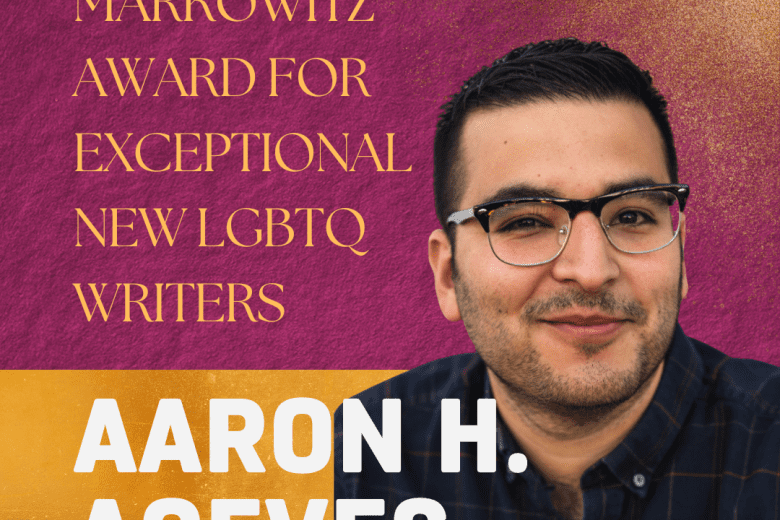
Lambda Literary has played a pivotal role in nurturing the development of exceptional new LGBTQ writers through the Writers Retreat for Emerging LGBTQ Voices, internships, and writing and performance opportunities. Supporting emerging LGBTQ writers is central to our mission: they are the future of LGBTQ literature. The Judith A. Markowitz Award for Exceptional New LGBTQ Writers recognizes LGBTQ-identified writers whose work demonstrates their strong potential for promising careers. The award includes a cash prize of $1,500. Two prizes are awarded annually.

Winner of the 2025 prize Aaron H. Aceves is a bisexual, Mexican-American writer born and raised in East L.A. He graduated from Harvard College and received his MFA from Columbia University. His fiction has appeared in or is forthcoming from Passages North, Epiphany, and The Iowa Review, among other places. He currently lives in Southern California after serving as an Early Career Provost Fellow at UT Austin. His debut young adult novel, This Is Why They Hate Us, was released by Simon & Schuster. It received multiple starred reviews and was named a Best Young Adult Book of 2022 by Kirkus Reviews.
Q1: How does your queer identity inform your work in the literary world?
Honestly, it offers endless potential. A TV writer named Alan Yang once said in an acceptance speech, “Thank you to all the straight white guys who dominated movies and TV so hard, and for so long, that stories about anyone else seem kind of fresh and original,” and I feel the same way about literature. At times, I feel a wave of disbelief wash over me when I’m writing something that could be considered novel in some way simply because bisexual Mexican boys and men are so rarely represented in books and stories, but I also feel as if I’m making great progress carving a path for others to use in the future.
Q2: Are there any queer figures that inspire you/your work in this field?
One of the incredible things about being queer is having queer ancestors, so even though some of my literary heroes wrote their last words a century ago or so, I still feel a kinship with them. I love Oscar Wilde, of course, E. M. Forster, and James Baldwin. I’m also continually inspired by current Latine young adult authors Adam Silvera, Aiden Thomas, Sonora Reyes, Jonny Garza Villa, and Racquel Marie.
Q3: What do you hope for the future of Queer Literature?
Intersectionality, intersectionality, intersectionality. I want any queer person with multiple marginalized identities to be able to pick up a book that they feel was stolen from their diary (or their dreams). I’ve gotten that comment from some of my readers, and it never fails to make me smile.
Q4: How do you explore the concepts of cultural and queer identity in your writing?
The key for me is not trying to do so. At least not consciously. I create main characters who happen to be Latino and queer like myself and side characters who reflect the people in my life, and I write about them, and any insight they or I gain is accidental in a way. I have to explore via character; it is both the vehicle and the North Star for discovery. Every other element of my writing is necessary, of course, but they’re challenging for me and can cause me to lose my way. Whenever that happens, I stop and reenter the story by way of my characters.
Q5: Has understanding your own personal queer identity brought you closer to your culture in new ways? Has this manifested in any of your works?
There’s this perception that Latine people are especially intolerant of queerness, and I haven’t found that to be the case, so in my YA, I purposely write parents who defy those expectations. As for my personal life, embracing my queerness has only led to embracing all parts of myself. If there’s no one way to be queer, there’s no one way to be Latino/Mexican/Chicano. Hell, there’s no one way to be a writer.
