


The Randall Kenan Prize for Black LGBTQ Fiction is offered in memory of celebrated author Randall Kenan. The award will go to a Black LGBTQ writer whose fiction explores themes of Black LGBTQ life, culture, and/or history. To be eligible, the winner of the prize must have published at least one book and show promise in continuing to produce groundbreaking work. The award includes a cash prize of $3,000.
This award was founded by sponsors Cedric Brown, Darnell Moore, Dr. L. Lamar Wilson, and Steven Petrow and is now supported by Cedric Brown and Steven Petrow and Julie Petrow-Cohen Family Fund of Triangle Community Foundation.
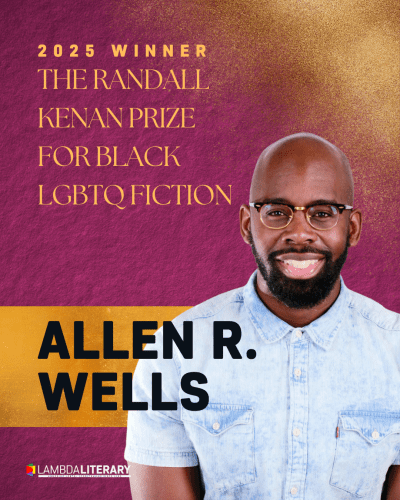
2025 prize winner Allen R. Wells is an accomplished author, engineer, and advocate for inclusion and representation in children’s literature. Born and raised in Jackson, Mississippi, Allen discovered his passion for storytelling at a young age. This early spark fueled a lifelong journey to create impactful stories that empower young readers.
A graduate of Tennessee State University, Allen holds a degree in Architectural Engineering and has built a successful career as a mechanical design engineer specializing in building systems.
He balances his engineering profession with his passion for writing, merging creativity and logic in every aspect of his work. Allen’s literary focus is on creating safe, imaginative spaces for children and young adults. His books celebrate diversity, foster empathy, and inspire readers to embrace their uniqueness. Some of his notable works include It’s Pride, Baby!, Danté Plays His Blues, and Yvonne Clark and Her Engineering Spark.
We get to know Allen R. Wells in a quick 5 Questions interview below.
Q1: How does your queer identity inform your work in the literary world?
For me, being queer isn’t just a perspective—it’s what drives my storytelling. It pushes me to write authentically, to highlight both the joys and struggles of life, and to create spaces in my stories where young readers can truly see themselves represented. As someone who grew up without that kind of reflection, my writing is a way to give kids what I never had: stories where their uniqueness is celebrated without shame, fear, or being erased.
Q2: Are there any queer figures that inspire you/your work in this field?
Definitely! James Baldwin’s sharp insight into identity and belonging stays with me every time I write. In children’s literature, authors like Julian Winters, Terry J. Benton-Walker, George M. Johnson, Kalynn Bayron, and Kacen Callender inspire me—each showing that queer stories can be heartfelt, humorous, complex, and deeply resonant for young readers.
Q3: What do you hope for the future of Queer Literature?
I hope for stories that are expansive—ones that go beyond trauma and coming out, though those are still very important narratives. I’d love to see queer characters take center stage in epic fantasies, rom-coms, mysteries, and adventures, where their queerness isn’t the only focus. I envision bookshelves where kids stumble upon worlds where queerness is just a natural part of life—woven into the story, just as it is in real life. I also hope that more stories about queer history and queer heroes are written, because knowing where we come from, our trailblazers, communities, and resilience, gives young readers a history to feel proud of and a sense of knowing that they are part of something big and great.
Q4: In your own words, why is it important for readers (queer identifying or not) to be exposed to LGBTQ+ inclusion and representation in children’s literature?
I believe that books have the power to foster empathy. When a child sees themselves reflected in a story, they feel seen and validated. When they meet someone who’s different, they develop compassion. Including queer characters in children’s literature helps break down fear and ignorance before they harden into prejudice. It sends a message to every reader: these lives, these families, these loves are real and deserving of respect.
Q5: What does the genre of children's literature have to gain from incorporating a more diverse range of identities, cultures, and narratives? How does it help to create a more inclusive future for future generations?
Children’s books rely heavily on imagination, and without diversity, without reflecting the actual diversity of our world, that imagination can be stifled. By amplifying these voices, we unlock new storylines, humor, myths, and cultural nuances that enrich the entire genre. This work lays the groundwork for future generations to grow up embracing inclusivity and possibility—knowing that difference isn’t something to be feared, but something to be celebrated. As those kids grow up, they bring this mindset into their classrooms, workplaces, families, and communities, helping to shape a more inclusive future.
