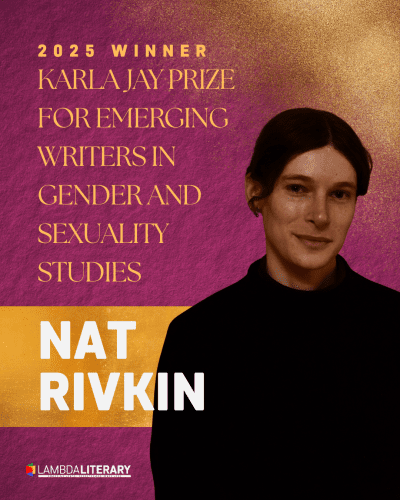
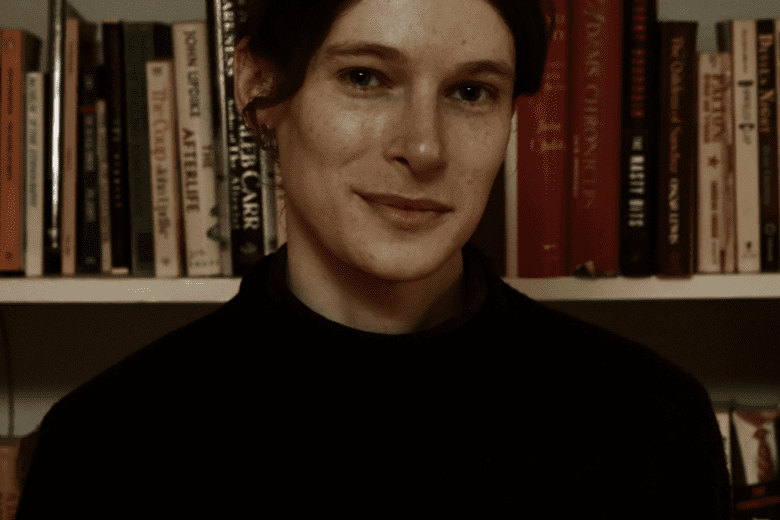
Nat Rivkin is a Collaborative Humanities Postdoctoral Fellow at Vanderbilt University. Her current book project examines four specific figures in late medieval and early modern literature: the monstrous birth, the virgin, the hermaphrodite, and the angel. Her writing has appeared or is forthcoming in College Literature, Early Theatre, Exemplaria, Medieval Ecocriticisms, TheRoutledge Companion to Queer Literary Studies, and Trans Milton.
Get to know Nat in a quick 5 Questions interview below.
Q1: How does your queer identity inform your work in the literary world?
I find myself thinking more about how literature gives form to desire––including but not limited to queer desire. Early modern texts so explicitly yearn for trans bodies, be they Milton’s angels who can “either sex assume” or Beaumont’s Hermaphroditus who will “nevermore a manly shape retaine.” That longing at the heart a text fascinates me and makes me continue writing.
Q2: Are there any queer figures that inspire you/your work in this field?
It would be difficult to name them all! I can offer some writers whose work I admire, such as Cameron Awkward-Rich, Kay Gabriel, Jules Gill-Peterson, Miranda July, and Virginia Woolf.
Q3: What do you hope for the future of Queer Literature?
I’d love to see more novels in which trans girls fuck shit up. Kai Cheng Thom’s Fierce Femmes and Notorious Liars is high on my list of literary bangers in this category.
Q4: What has been the most interesting thing you’ve discovered while exploring the connections between modern-day queer identity/art to medieval and early modern literature?
I keep returning to Eve’s surgical birth in Milton’s Paradise Lost, which, I suggest, exposes the Edenic origins of womanhood as enduringly trans––albeit in an epic turned biblical fan fiction.
Q5: How has your exploration of gender studies within literature informed your own personal queer identity?
I will say that trans literature has illuminated many parts of my life in a manner I couldn’t have known or anticipated. In Kay Gabriel’s words, “It’s sort of excruciating and also pretty familiar.”