

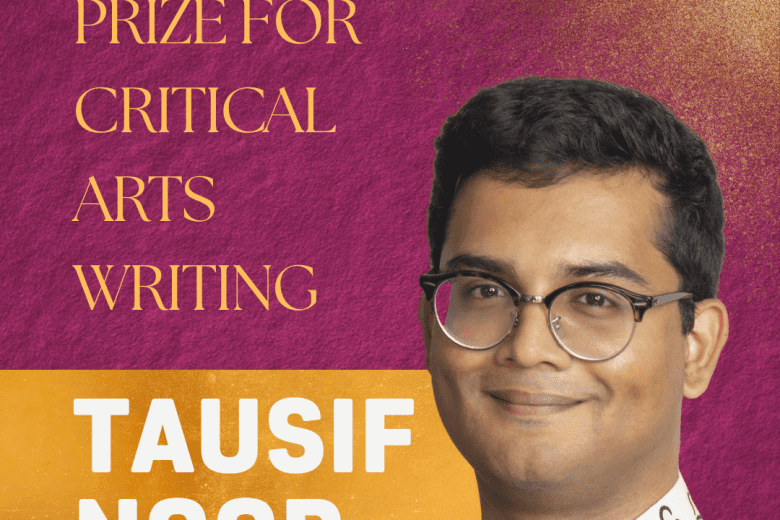
The Pat Holt Prize for Critical Arts Writing is presented in memory of the celebrated author and long-time SF Chronicle book review editor Patricia Holt and honors LGBTQ Critical Writing on Arts & Literature. The award will go an LGBTQ arts critic or literary reviewer committed to examining queer works of art and culture, as Holt ground-breakingly did for 16 years. This award is made possible by Lesbians for Good, a fund of the Horizons Foundation, and includes a cash prize of $4,000.

Winner of the 2025 prize Tausif Noor is a critic and curator whose writing has appeared in publications such as the New York Times, the New Yorker, the New York Review of Books, Aperture, frieze, and The Poetry Project Newsletter, as well as various artist catalogues and edited volumes. He is the recipient of a 2022 Andy Warhol Foundation Arts Writers Grant for Short Form Writing and the 2023 Grace Dudley Prize for Arts Writing from the Robert B. Silvers Foundation. Based in Oakland, California, he is a PhD candidate in the history of art at the University of California, Berkeley and Curatorial Associate at the Berkeley Art Museum and Pacific Film Archive.
We get to know Tausif in a quick 5 Questions interview below.
Q1: How does your queer identity inform your work in the literary world?
As a queer writer of color, I’m writing from a position that’s necessarily minoritarian and politicized. make it a point to recognize and identify that kind of positioning in the subjects I write about, whether that’s in visual art, film, performance, literature, or poetry. I don’t just mean recognizing an artist or writer’s identity; rather, it’s about taking into consideration the social and political conditions under which a work is made. An artist’s gender and sexual identity can be part of that, but it’s also about the historical and social context of a work—how it was produced, how it circulates, and the kinds of discourses it has generated. I tend to abide by the idea that anything we think of as a discrete object is actually enmeshed in a web of relations, and my writing tries to take that into account.
Q2: Are there any queer figures that inspire you/your work in this field?
There’s almost too many to name, but to list just a few figures, in no particular order: John Ashbery, Thomas Lanigan-Schmidt, Wayne Koestenbaum, Sophia Dahlin, June Jordan, Shiv Kotecha, William E. Jones, Chitra Ganesh, Kevin Killian, Nayland Blake, Robert Glück, Frank O’Hara, Violet Spurlock, George and Mike Kuchar, Kay Gabriel, Sunil Gupta, Rainer Diana Hamilton, Larry Rinder, Virginia Woolf, Bill Arning, Allyson Mitchell and Deirdre Logue, Gertrude Stein, and Ismail Merchant and James Ivory. There are many more; it’s a list that goes on and is ever-growing.
Q3: What do you hope for the future of Queer Literature?
I hope that queer literature in all its forms continues to take risks in the face of political and social repression. I don’t think that any discipline, or history for that matter, moves forward in a simple forward progression, but rather proceeds within and in response to struggle; I think that art and politics have both separate and intertwined forms of struggle. That said, I think it’s important to recognize the forms of progress we’ve made and the people to whom we owe that progress. Any look to the future has to be simultaneously be a recognition of the past.
Q4: How do art history and literature connect to the queer community you find yourself in?
It’s hard for me to even separate a sense of community from my work in art and writing; I’d go so far as to say that I’m part of a queer community because of my work and my love for visual art and poetry, film, and literature. The overwhelming majority of my queer friends and the people I see as part of my queer community are engaged in art, poetry, and writing in some form or another, and it’s because of these people that I even dare to do the things I do.
Q5: What advice do you have for young/aspiring queer artists wanting to positively impact the community and society beyond it?
The most important piece of advice I can offer is to keep going, and to speak out against the things that matter to you. In whatever form you can, in whatever context you’re in, you should speak out against injustice and advocate for those who can’t speak out on their own. Say no to war and imperialism and genocide; stand up for those who are facing oppression. That’s all that we can do in the limited time that we have. Credentials and accolades aren’t mportant. What’s important is to live your life in a way that doesn’t cede to dominant forms of authority. Most people do not, and may never, recognize the impact that they’ve had on a community or society at large, but that doesn’t mean that the impact isn’t there. This is why I am so invested in taking stock of history and seeing what came before. An artwork, or poem, or film, or piece of writing made a hundred years ago that can still transform your life, so it’s important to keep working at the art you want to make—not because it will necessarily outlast you, but because you don’t know how it will endure, and for whom. Our lives, and our art, are ultimately ephemeral, but there’s always the possibility that the work will ripple out and mean something important to someone, somewhere, sometime.
