

The Denneny Award for Editorial Excellence is named in honor of Michael Denneny, who founded the first ever LGBTQ+ imprint at a major publishing house, was essential in the publishing of literature dealing with the HIV/AIDS epidemic, and so generously shared his talents with writers right up until the end of his life. The award will go to an editor whose commitment to the publication of LGBTQ+ writers and literature contributes significantly to the advancement of the LGBTQ+ community. The Denneny Award is the only editorial award that not only recognizes the support provided by editors to the literary community, but also the importance of editors in the advancement of a social movement. The winner will receive a cash prize of $2,500.
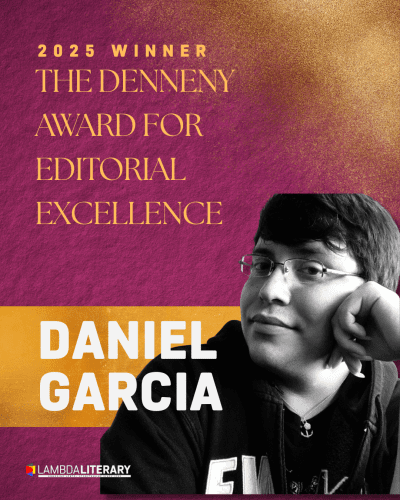
DANIEL GARCIA is a writer, editor, and educator. Daniel’s essays appear in Guernica, Michigan Quarterly Review, Passages North, Quarterly West, Shenandoah, The Kenyon Review, and elsewhere. Poems appear in Electric Literature, Gulf Coast, Pleiades, Ploughshares, swamp pink (formerly Crazyhorse), and others. Supported by scholarships, fellowships, and residencies from Lambda Literary, SmokeLong Quarterly, Carolyn Moore Writers House, Vermont Studio Center, and more.
Daniel currently serves as the InteR/e/views Editor for Split Lip Magazine and the Micro Editor for The Offing. As an educator, Daniel has been a mentor with SUNHOUSE Literary and was recognized by YoungArts in 2025 for outstanding mentorship and artistic guidance. Daniel’s essays also appear as Notable Essays in The Best American Essays. Find Daniel at danielwritespoetry.com or on Bluesky @iloveyoudaniel.bsky.social.
We get to know Daniel in a quick 5 Questions interview below.
Q1: How does your queer identity inform your work in the literary world?
For me, queerness is central to who I am: as a reader, as a writer, as an editor. It tasks me, by way of my worldly, material movements, with the assignment of drafting new worlds—or at least the assignment of expanding or pushing against the confines around this one. I know that sounds a bit woo-woo, but that’s because, at least for me, it is; I see queerness as a site of possibility, of limitlessness. Something I often tell people: You are given, and so you owe. Because queerness has given me access to a perspective of seeing the world, I am obligated to give my time, my efforts, my energy. In this way, queerness is communal for me, especially as an editor—I must share of my time with others so that they can draft their own worlds too, artistically or otherwise. Queerness, for me, is more than just a facet of one’s gender and sexuality—it’s an opportunity to participate in creation.
Q2: Are there any queer figures that inspire you/your work in this field?
Beyond myself, a handful of queer writers and artists I admire and/or who inspire me that come to mind: Kelsey O. Daniels, Rose Zinnia, Dr. Rita Mookerjee, Ocean Vuong, Félix González-Torres, James Baldwin. There’s really so many queer artists, across many artistic disciplines, but those are a few. In these people—reasons to show up for myself, for others; to stretch and [re]imagine and consider and be challenged; to try and to try again. Pathways towards something that looks like freedom.
Q3: What do you hope for the future of Queer Literature?
Because literature is often a reflection of the world, my dream for the future of queer lit mirrors my dream for humanity at large: a world where, in the words of my good friend and fellow dreamworker Kelsey O. Daniels, with a nod to Megan Thee Stallion, “hot girl shit is allowed to flourish.” When I say I dream of a world where hot girl shit is flourishing, I mean that, beyond the obvious, I dream of a world where queer literature is not a site of political legislation. I dream of a world where queer literature is not subject to censorship and fascist scrutiny. I dream of a world where a body of work mirrors a human body; that they may exist freely without apology or shame. A future where queer literature—and by proxy, the people who create it, the bodies that render it into something legible—are free of systemic violence and bigotry. In an email exchange I had with a (now) editorial colleague I met at Vermont Studio Center, A.D. Lauren-Abunassar, a Palestinian-Irish-American writer, she’d mentioned the way writers often treat their work as a shelter for an answer to something, rather than as a shelter for a question towards something. She was talking about essays specifically, but I think this applies to literature as a whole. What I’m saying there is that the future I dream of for queer literature is a future—and it sounds a little hokey, I know—full of curiosity and discovery and wonder (and good marketing too); a future where queer writers are thriving and are able to make a sustained, comfortable living off their work.
Q4: What social impact(s) have you noticed/are you most proud of in terms of your accomplishments in the writing, editing, and educational fields?
Honestly, the thing I’m most proud of is the work that I do as an editor—specifically, I’m really grateful and happy to not just be an editor, but to directly put money in the hands of the people. Now more than ever, it is difficult to make a living, or any sort of money, off of your writing, and even though the magazines that I work for can’t pay writers exorbitant amounts of money, I do know what it’s like knowing that any little bit of money helps; there have been times in my life where publication honorariums have kept my head above water, helping me to pay for basic living expenses like rent and groceries. To be in a position where I can give writers money is an immense privilege, and it gives me a good deal of satisfaction to be in a position where I can platform them in a way that is conducive to their artistic growth. On a personal level, the biggest social impact that I’ve noticed within my artistic work is the impact it’s had on my own life. Being a writer, editor, and educator has made me a more empathetic person, it has made me more community-oriented, it has helped me build friendships and working relationships with other artistic professionals. My work has been foundational for all aspects of my life, especially how these things intersect and overlap with each other (I’m thinking of the way my work as an editor has given me a sharper eye in writing and editing my own work, for example). It’s helped me be more and more invested in the development and wellbeing of myself and others. I look at the world more critically. My work makes me make sense of my life, of the landscape I swim through, both materially and emotionally. It has taught me patience and how to extend it with grace. It has shown me how to want, how to long, yearn. It has shown me the unruly and sometimes utterly useless weight of desire and has asked me to bear it. It has helped me chart my joys, my loneliness, my aches, my wonders. It has shown me the gorgeous folly in taking my spot in line and eagerly waiting for the moon to get back to me with a love poem of its own for me.
Q5: What do you hope to continue to teach and share with other queer minds/artists?
I can only speak for myself here, but something I emphasize to other artists, especially writers, is that the process of artmaking, regardless of medium, is one that should be fun. It should be pleasurable. It should be clarifying. It should feel like medicine. It should feel intimate. It should feel like there’s more air in the room. It does for me. Desire is life, and nothing makes me feel like a kid—open, limitless, endless—more than spending time with language in a deliberate and devotional way.
Certainly, there are times where I need a break, or times where I don’t want to write or work and I have to simply push through because of deadlines, but more often than not, not writing is a fatiguing, frightening, and colorless set of circumstances for me. To write and to not write require discipline, and the word discipline is a synonym for the word decision. Writing is as much a physical and mental practice for me as it is a wellness and spiritual one. I get ill when I don’t write. That’s not an exaggeration, and it’s not romantic either. Things make less sense, I feel less connected with myself and the world, I stammer more, my head hurts, I don’t sleep well. Speech becomes difficult. I move further from passion and the ability to pull my eyes from the sidewalk. I wilt. It is harder to not write, to not do my art.
And so what I’m really getting at here is that we should all take ourselves and this whole artmaking thing less seriously. That’s not to say that we can’t or shouldn’t have discipline—see the above re: discipline; and also that there is no other way to be writer other than to write with some measure of consistency—but that, when I say we should take making art less seriously or that it should be fun, I mean: Too often I’ve seen too many artists consign themselves to the notion that one must be constantly making art or making money from it to be worth anything. It’s important to feel good about your artistic output, sure, but never better than feeling good as a person. Chaining oneself to productivity is just putting burnout on speed-dial. It is premeditated exhaustion. De-internalize capitalism today. Evict this notion of “good” and “bad” writing while you’re at it. Moralizing your work before you’ve even given it a chance to formally exist serves no one, least of all yourself. If you’ve never done this or it is uncomfortable or unfamiliar or you are concerned with judgment, let me offer you some words by Mercury Stardust, a trans handywoman: “You’re worth the time it takes to learn a new skill.” Writing is so much easier when it is in the pursuit of pleasure and replenishment.
So expand your toolkit. Have fun. Let it be passionate. Hold whatever image that’s come to you in your head gently. Allow the synapses in your brain to come alive. Electric, invigorating, possible. And then loop arms with every iteration of yourself: past, present, and future. Feel everything narrow to a single unified point inside a room where there are no further obstacles. Feel the syllables come up, feel the weight of consonants and vowels on your tongue. That’s how it happens for me. I hope it happens this way for you. Be ruthless in your whimsy. This sounds contradictory. That’s because it is and isn’t. This is what I hope to continue sharing with other queer artists. When I say making art should be fun, I’m saying that it should be in the service of getting you closer to yourself. If others get something out of it, great. But you must do this—first, always—for the person gazing back at you in the mirror. You must put it in front of passion. You must treat it like it is a lover, something precious to be guided in and held close as if on a dance floor, to be softly murmured to and cherished with abandon and released with gratitude and guided in once more. You must treat it like the first time you met yourself.
