


Lambda Literary’s Jeanne Córdova Prize for Lesbian/Queer Nonfiction, in memory of the beloved activist and author, honors lesbian/queer-identified women and trans/gender non-conforming nonfiction authors. The award will go to a writer committed to nonfiction work that captures the depth and complexity of lesbian/queer life, culture, and/or history. The winner of the prize will have published at least one book and show promise in continuing to produce groundbreaking and challenging work. The award was introduced in 2018 and includes a cash prize of $2,500.
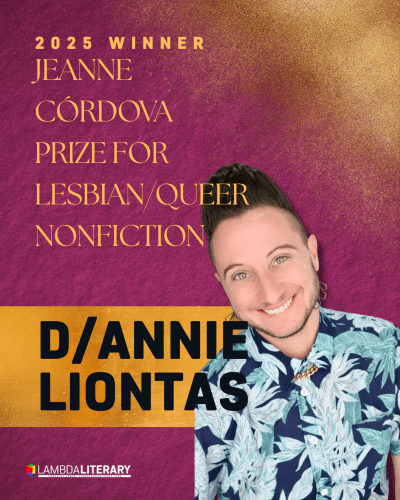
Winner of the 2025 prize D/ANNIE LIONTAS is the trans-genderqueer author of the memoir Sex with a Brain Injury: On Concussion and Recovery, which won the ALA’s 2025 Stonewall Award for Nonfiction, and the novel Let Me Explain You. Their work has appeared in The Atlantic, The New York Times Book Review, Oprah Daily, and elsewhere. An Associate Professor at George Washington University, LIONTAS helped secure a Mellon Foundation grant on Disability Justice to bring storytelling to communities in the criminal justice system. They co-host the literary podcast LitFriends and live in Philadelphia with their wife, dog, and Email the rabbit.
We get to know D/Annie is a quick 4 Questions interview below.
Q1: How does your queer identity inform your work in the literary world?
As a trans-genderqueer writer who began gender affirming therapy in their forties, and an immigrant who lives with brain injury, I write against erasure. I write out of queer joy and resilience. I ask what it means to be seen as foreign in one’s own body and nation. I hold onto bell hooks, who sees the confessional as prelude, the personal as a way to reach beyond the self. I want to foster empathy and build connections between readers who in real life would probably trash talk each other. I guess I’m also genre-queer, because I refuse to be confined, moving between poetry, prose, flash, the lyrical essay, the novel—even my nemesis, the short story—in order to say what must be said. Almost always, I rely on humor—a queer’s sharpest tool—to speak truth.
My work directly and thematically takes up “The Barthes Effect,” which argues that creative nonfiction inherently diverts from a formal point-of-view to defy all classification; not only does it resist conventional forms, it also queers them. As hybridist David Lazar tells us, “the desire of the essay is to transgress genre.” Drawing on the pageantry and parody of drag—truth hiding in plain sight—my writing masks and reveals.
Q2: Are there any queer figures that inspire you/your work in this field?
I write in the shadow of queer artists who insist on putting blood on the page, including bell hooks, James Baldwin, Dorothy Alison, Eileen Myles, Melissa Febos, Donika Kelly, Justin Torres, Andrea Lawlor, Paul Lisicky, RuPaul, Queen Latifah, and George Michael, who is my true gender. As a writer of a queer-crip memoir, I am grateful for theorists like Robert McRuer and Merri Lisa Johnson. I’m also driven by the homophobic 80s, the people in Florida who sneak out at night to repaint the Pulse Club rainbow crosswalk, trans youth, drag queens, and the good people in Philadelphia who threw up that mural trolling JD Vance.
Q3: What do you hope for the future of Queer Literature?
Bertolt Brecht has this beautiful quote. He writes, “In the dark time, will there be singing? Yes, there will be singing. About the dark times.” I have always thought of queer writing as a kind of song to guide us through the long night. I think it must be that, too, in the future—however uncertain or fearful we may be. We must continue to use the page to subvert inherited false narratives and raise consciousness. When fascist powers aim to silence us, telling our stories becomes a radical act. We keep the fires lit ‘till morning.
Q4: What does Transgender Literature represent for you?
Trans lit is about belonging, identity, transformation. It’s a powerful archive of resistance and reclamation. It does not simply challenge the cisnormative lens through which literature is too often written and read: it creates new space for us to exist—on the page, in our bodies, in our lives, in communities and nations. To me, transgender literature is a subversive form of survival and storytelling. Trans lit reclaims the right to exist, to imagine, to be complex, to be messy, to be whole.
